
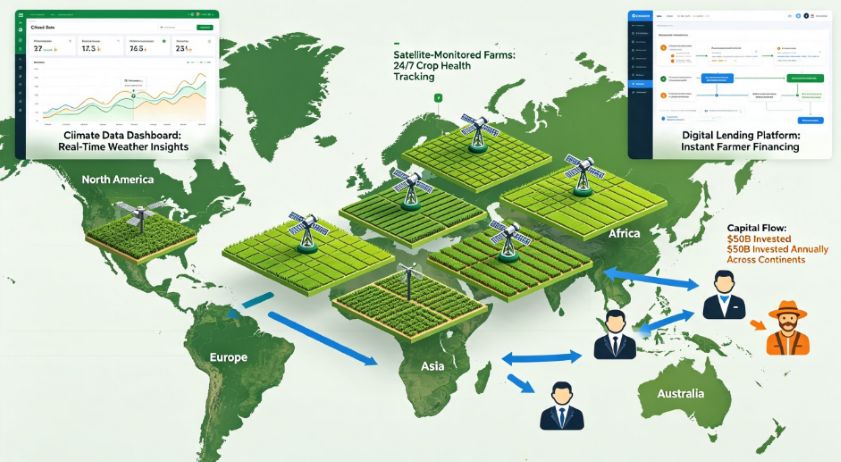
Agriculture supports the livelihoods of more than 2.5 billion people worldwide, while climate change continues to increase production risks and disrupt food supplies. Research from FAO shows that extreme weather events have become a major cause of crop losses, making traditional financing less effective for farmers who face growing uncertainty.
How innovative financial instruments and data-driven investment are transforming farming resilience and food systems worldwide. Financial systems are gradually adapting through products designed around agricultural realities instead of conventional lending standards. This shift helps producers manage weather risks, improve productivity, and strengthen long-term food security while attracting investors seeking measurable environmental and economic outcomes.
Why Agriculture Needs a Financial Overhaul
Many farmers, especially smallholders, struggle to access affordable credit because lenders often view agriculture as a high-risk sector. Findings from The World Bank indicate that limited collateral, unpredictable weather, and volatile commodity prices continue to restrict investment across developing economies. These financing gaps slow modernization and reduce resilience against climate shocks.
Experts note that better financial tools can encourage sustainable farming while reducing risk for lenders. Digital technologies, satellite monitoring, and improved climate data now allow financial institutions to assess agricultural performance more accurately than before.
Three Game-Changing Financing Models
Climate-Indexed Loans
Climate-indexed loans connect repayment conditions to measurable weather indicators such as rainfall or temperature. Reports from CGAP explain that these products reduce pressure on farmers after severe droughts or floods because repayment schedules adjust when predefined climate thresholds are reached.
Revenue-Linked Financing
Revenue-linked financing ties repayments to farm income instead of fixed monthly amounts. This approach provides greater flexibility during weak harvests while allowing lenders to participate in stronger production years. Studies published by IFAD suggest that flexible repayment structures can improve financial inclusion for rural producers.
Blended Public-Private Capital
Blended finance combines funding from governments, development banks, charities, and private investors. Reports from OECD show that this model helps reduce investment risk and attracts larger pools of private capital into sustainable agriculture projects that might otherwise remain underfunded.
Global Examples Delivering Results
Kenya has expanded digital agricultural lending through mobile financial services, helping farmers access credit faster while improving repayment monitoring. India has strengthened weather-based crop insurance programs that complement agricultural lending. Meanwhile, Latin American producers have benefited from sustainability-focused investment supported by the Inter-American Development Bank, encouraging climate-smart farming practices.
Large commercial producers are also adopting sustainability-linked financing tied to environmental performance. Research from Rabobank highlights growing demand for loans connected to soil health, emissions reduction, and water management goals.
Supporting Productivity and Food Security
Better financing allows producers to invest in improved seeds, irrigation systems, precision agriculture, and climate-resilient technologies. Data indicates these investments increase yields while reducing production risks. FAO emphasizes that resilient agricultural systems are essential to meeting future food demand as the global population continues to grow.
Challenges That Still Need Attention
Several barriers remain before these models can reach their full potential. Reliable agricultural data is uneven across many regions. Financial products often lack standardized measurement frameworks, making comparisons difficult for investors. Smaller institutions may also struggle with the cost of advanced technology and climate analytics.
Building the Next Generation of Agricultural Finance
Governments can strengthen legal frameworks that encourage sustainable investment while expanding digital infrastructure in rural communities. Development agencies and NGOs can provide technical support, farmer education, and risk-sharing mechanisms that attract private lenders. Financial institutions can continue refining data-driven lending models that reward resilience and responsible land management.
Global cooperation between policymakers, investors, researchers, and farming communities will determine how quickly these innovations scale. Continued collaboration offers a practical path toward stronger rural economies, more resilient food systems, and greater protection against future climate challenges.